The issue of sustainability keeps evolving. There are new policies, new regulations, and there’s always a new stage that companies reach when it comes to becoming or being sustainable.
One of the biggest challenges and opportunities for becoming sustainable is the supply chain.
In this article – based on the presentation given at DENOG16 and more recently at NetUK2 – Nicol Nogradi (Account and Sustainability Manager at Inter.link) shares her insights about creating a sustainable supply chain in the network industry and specifically addressing the Scope 3 carbon emissions category.
Why is Carbon Footprint Relevant to the Network Industry?
The network industry has a large global carbon footprint (2% which is similar to the footprint of the aviation industry) and a high growth rate.
Some projections state that if we do not change anything and just have the improvements and growth of the industry on its own without any reductions, the network industry can take up 14 per cent of the global footprint by 2040, which is quite a significant growth.
This doesn’t have to happen. This example is just showcasing that there’s a lot of room for improvement, and that we can actually make a global impact as an industry.
Explaining Scopes 1, 2, and 3 Carbon Emissions
Scopes 1, 2, and 3 are emission categories defined by the greenhouse gas protocol.
Scope 1 is everything that’s the direct emission of your organization. Offices, factories or company cars go into this category.
Scope 2 is everything that’s energy purchase, so if you charge an electric vehicle, that will go into this category, but also if you purchase electricity for your data centre. Every type of energy that you purchase will be covered by this.
Scope 3 is technically everything else, so it’s the entire supply chain, and these are all indirect emissions that affect your company. Every time you buy products, services, or anything else that is part of your supply chain (and it is not part of the first 2 categories), this is the category that it goes through.
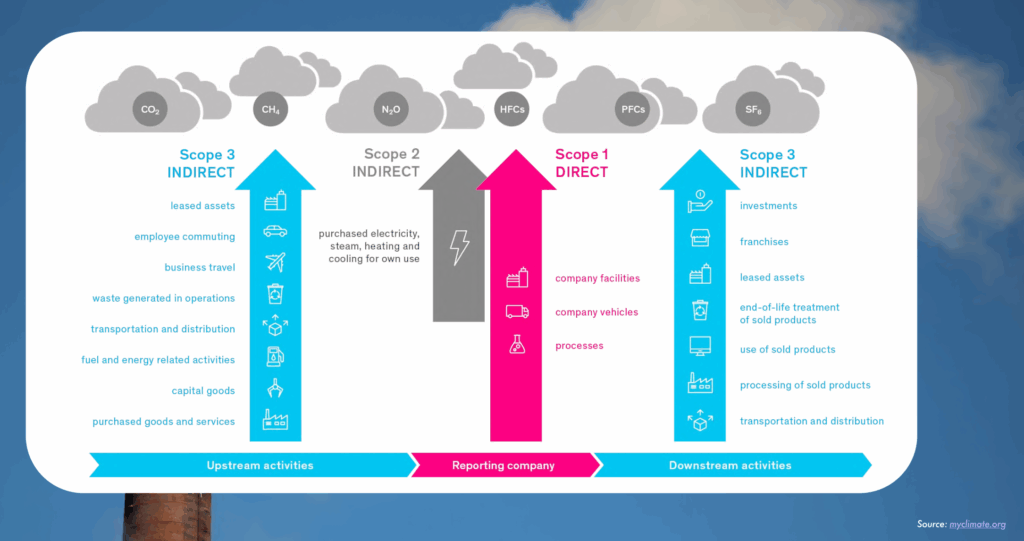
Scope 3 is very complex, as shown by this diagram above. Everything that is in the blue is scope 3. It even has 15 subcategories which includes upstream and downstream activities, so you see that scope 1 and 2 are much simpler with fewer categories.
To bring up a few examples, the graph below displays statistics from 2020 (from CDP, a platform where companies can submit their footprint and sustainability goals and details) with scope 1 and 2 shown as orange and green.
Orange and green are hardly visible at all compared to blue which represents scope 3. This data has probably changed somewhat in the last couple of years, but one thing is clear, that despite the size of the whole emission, scope 3 is a large part of it.

What was shown above for Scope 1, 2, and 3 was a bit more high-level, but the graphic below is what exactly is covered in our industry. Scope 1 is vehicles and offices etc, and scope 2 is still energy, but energy that is going into these categories, so, electricity for amplifiers, for PoPs, for partner data centres, and so on.

The biggest chunk is Scope 3 which is 85 per cent on average. This will change across companies, but the statistics show that this is for most companies between 70 and 100 per cent of emissions.
Scope 3, or the footprint of the supply chain, is 26 times greater than the corporation’s own operational emissions. This is crucial because every company has direct influence over own operational emissions, but the supply chain is something harder to tackle.
Sustainability Commitments in the Industry
There have been some regulations recently. The CSRD has incentivised a lot of companies to start to measure their footprints because it became obligatory to report on footprints.
This is ongoing, so the bigger companies with more than 500 employees are already impacted, but by the end of 2028, this will cover even SMEs, so you will have to measure your footprint.
The network industry agreed to a greenhouse gas emission reduction of 45 per cent between 2020 and 2030. This is in line with the Paris Agreement as well which shows that there are some agreements on how to reach science-based targets, agreements on how to develop the science-based pathway for the industry.
To keep of track with these goals and targets, companies pledge to reduce their emissions by 45 percent.
With the supply chain being 85 per cent of emissions on average, this reduction can only be made if you also focus on your supply chain and scope 3. It’s not possible to reduce your footprint 45% if you’re only reducing scope 1 and 2, which a lot of companies are doing right now.
Challenges with Tackling Scope 3
However, there is a reason why scope 3 is harder to tackle.
Three of the main challenges are due to its complexity. Scope 3 has a lot of subcategories, there’s a lot of standardisation missing, and you have to work a lot, and it’s very time-consuming.
There’s also a lack of control. You do not have direct control over your suppliers, so you can try to incentivise them, but every partner in your supply chain has its own processes, organisation, agenda, goals, measures that they’re taking, which sometimes it’s pretty challenging to align with your own goals.
And then there are data quality issues.
There is not only a lot of data, but in another sense there is also not much data. A lot of smaller companies do not have the resources or do not have the capacity and time to actually measure these. So, there are a few challenges, however, there are a few approaches that you can take to try to tackle this.
Practical Approaches to Reduce Scope 3 Emissions
In the image below, under some of the categories there is a little green tick. That means that interlink is focusing or currently prioritising these topics.
That doesn’t mean that the other topics are not equally important, or you shouldn’t attempt those, it just means that right now based on our sustainability journey, these are the topics where we have more experience in, and where we’ve been taking several steps to make sure that we’re on the right track.

Prioritise Measurement and Data Collection
In order to take actions you must collect your data. You have to see your measurements, you have to see where your hot spots are, and recognise your highlighted suppliers.
There might be only a few suppliers where you can already make a big impact and collaborate with. But for that, you really need to map your supply chain and its emissions, so wherever it’s possible, reach out to your suppliers and collect life-cycle assessments.
Next to this, you can also engage and support suppliers by establishing partnerships. For example, if you know there is another company that has the same goal, you can negotiate together with an electricity supplier.
You can also collaborate on building data centres or investing into offset programmes. Every company is different and there are so many possibilities. If there are more companies collaborating, you also have more power and you can take bigger steps together.
Implementing sustainable procurement practices
Select your suppliers in a way that they align with your responsible environmental goals.
For this you can develop supplier scorecards. This depends on company preferences and you have to decide what are the measurements you want to collect. You can look at electricity, targets, product components, and many other areas.
There’s no ‘one size fits all’ so it is worth checking to see what data you are interested in getting from suppliers because if you overload the data then you might miss the point of collecting this information.
Based on the supplier scorecards, you can decide which supplier you prefer.
For example, if you’re offsetting your emissions, that also costs something, so there might be a cheaper supplier but then if you add the offsetting cost on top of that later, it can mean that choosing another supplier that’s more sustainable actually makes more sense for you in the long term.
What Data Should You Collect from Suppliers?
There’s a lot of data which can be collected from suppliers. In Inter.link’s experience, the main categories of data that are actually beneficial and are also enough to create a map of uh your supply chain are: invoices, service level footprint, targets/goals and electricity they use, and life cycle assessments.
Invoices
One important category of data is invoices. This is an excellent starting point, so even if you don’t reach out to your suppliers with this, you can already make some estimations.
This method is called spend-based estimations which is working with emission factors. The only negative part of it is that this is working with industry averages, so your missions might actually be lower or higher than those averages. Suppliers provide more accurate data but the averages are still quite reliable.
Service Level Footprint
What is the emission footprint of a service that you’re consuming?
This is the most complex of all because there are no standards for this. There are a few companies who already calculate this and can provide this ,but it’s still challenging to go down to analyse the service use of a customer. But it is still worth asking your suppliers.
Targets/Goals and Electricity Use
It is important to ask your suppliers about their targets and goals to make sure you are both going in the same direction. Also you can always ask about electricity use. Are they using renewable energy or not?
Life Cycle Assessments
Life cycle assessments give an overview of a product and how sustainable it is at all stages from the very start (including what materials are used to create it), to it being used by a customer, and at the very end. Getting this footprint information is extremely useful. Some suppliers provide this information on their website but sometimes you need to ask.
3 More Practical Steps to Reduce Scope 3 Emissions
Establish Contractual Clauses for Sustainability
Establishing contractual clauses for sustainability is becoming more popular as well because this is a way to set specific terms and to really make sure that it’s a targeted approach. This is supplier specific and you can always discuss what steps you will do together to reduce the footprint.

Even if your company doesn’t have a legal department uh that’s still fine because you don’t need to be a legal guru to manage these clauses. The screenshots above are from a nonprofit’s organization website called Chancery Lane and they have a lot of clauses and cases prepared on their website already.
The screenshots has just a few examples and you can always modify this to what you think is better for you so in this case it really focuses on how the company should strive for more becoming more energy efficient uh there’s a focus on renewable energy sources and there’s also waste reduction and monitoring and reporting.
You can ask suppliers to give you an annual report on the sustainability practices and goals and progress that they’re making. They might already have something on their website but you can ask for more tailored data that’s relevant for your company.
You can ask them to use renewable energy sources, or if they do already this clause ensures that this will continue. You can also set targets for emission reduction and check how you can work towards the goal together. This will benefit your company but also it benefits the supplier because most sustainability initiatives have a cost return in the long term because you save resources, time, and so on.
Promoting Circular Economy Practices
This is more important for companies who produce products because in these cases the designing process is already an important step in order to make a product more reusable, recyclable, and to promote a longer life cycle or a lower electricity use.
There are also several companies already who have reuse and recycle programs, so if you have your hardware lying around and it’s not working anymore then check whether your supplier has a recycling program.
Collaborate Across The Industry
It is important to remember that this is an industry effort and although companies individually work towards their goals, scope 3 is the supply chain so it involves a lot of participants.
You can always share the best practices and strategies with other companies and look out for resources which have already been shared which can benefit you.
In Conclusion
The key takeaway from all this information is that collaboration is key.
The supply chain takes up a large part of the carbon emissions footprint which means that this is an industry initiative. It is a collaborative approach so if you reduce your own footprint, it actually reduces the footprint of all your clientele. The whole industry benefits from this because if you’re talking to your suppliers and they’re making the reductions then this will have a trickle-down effect across the whole industry.
Also, after scope one and two reductions there is a point beyond which you cannot reduce your footprint if you’re not dealing with your supply chain and the emissions coming from the supply chain.
That is why this it is a collaborative approach that the industry needs to take to actually tackle the emissions industrywide.