
The BGP Origin attribute has been part of Internet routing for decades, helping routers determine the preferred path when multiple routes are available. But what happens when networks stop treating it as an indicator of route origin and start modifying it?
Research presented by Inter.link’s James Bensley at RIPE 91 suggests that a significant number of major transit providers are rewriting the Origin attribute before propagating routes—raising important questions about transparency, competitive routing practices, and whether the attribute still holds meaningful value in modern networks.
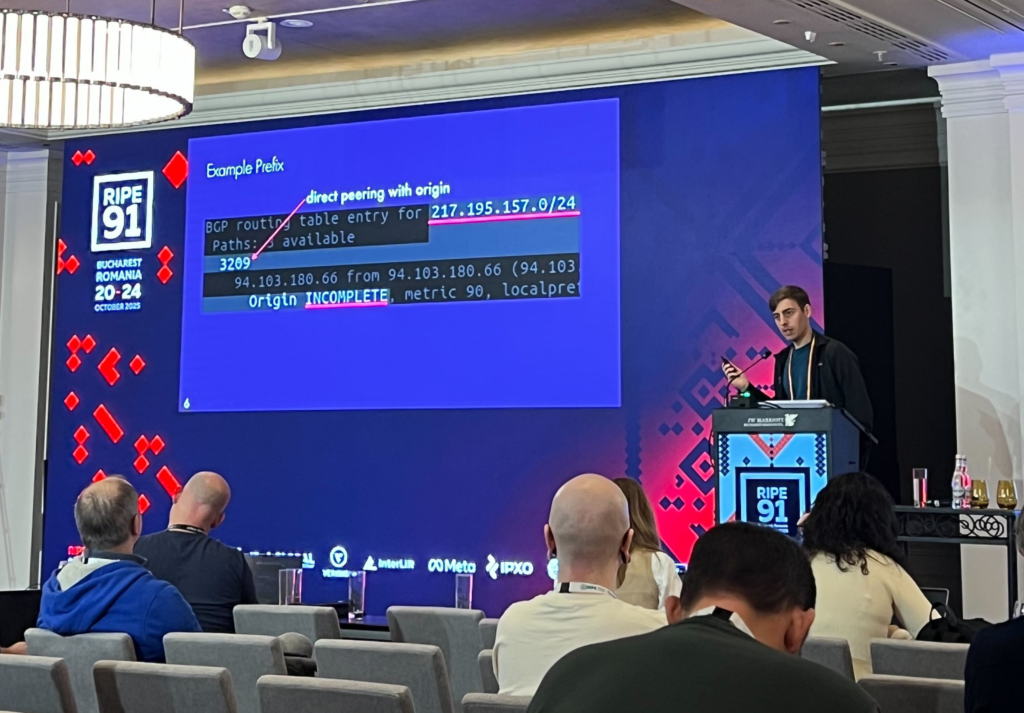
Understanding the BGP Origin Attribute
The Origin attribute is a mandatory BGP attribute attached to every route announcement.
There are three possible values:
- IGP (Interior Gateway Protocol) – indicating that the route originated within the announcing autonomous system.
- Incomplete – indicating that the route was redistributed into BGP from another source, such as a static route.
- EGP (Exterior Gateway Protocol) – a legacy value associated with the now-obsolete EGP protocol.
In modern networks, EGP is effectively irrelevant. Most routes use either IGP or Incomplete, with approximately 90% of global prefixes carrying an IGP origin.
Although Origin appears relatively low in the BGP path selection process, it still influences routing decisions: when all other attributes are equal, BGP prefers routes with an IGP origin over those marked as Incomplete.
That preference creates an incentive.
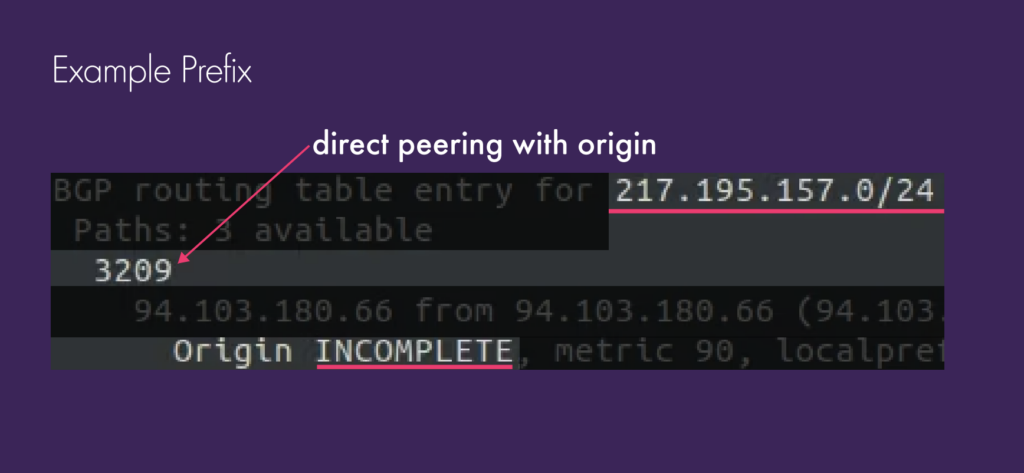
Example of Incomplete Origin Type
The Discovery
While analysing global routing behaviour, Inter.link observed a pattern that shouldn’t have existed.
A significant number of major transit providers appeared to be rewriting incoming route announcements and advertising them onwards as Origin IGP, regardless of their original value.
Using full routing table data and publicly available Looking Glass servers, Inter.link found evidence suggesting that approximately half of the major Tier 1 providers were performing this type of modification.
The behaviour was not publicly documented in product specifications, peering policies, or service descriptions. When questioned, some providers explained the practice as a method of maintaining consistency across their networks or simplifying internal routing operations.
But those explanations raise further questions.
If the Origin attribute is intended to reflect how a route entered BGP, why alter it during propagation?
A Competitive Advantage Hidden in Plain Sight
The technical explanation is straightforward. The commercial incentive is even clearer.
Because IGP is preferred over Incomplete, changing the Origin value can influence path selection. Even if the attribute only comes into play occasionally, those occasions can still affect traffic flows.
If one transit provider rewrites Origin attributes and another does not, the provider performing the rewrite may win traffic in situations where competing paths are otherwise equal.
From a transparency perspective, the situation becomes more complicated.
Customers don’t usually know when routing attributes are being manipulated. They simply see traffic preferring one provider over another. Without transparency, identifying why becomes almost impossible.
When Transparency Meets Competition
Inter.link deliberately chose not to manipulate attributes such as Origin or Local Preference, believing that transit providers should remain as transparent as possible.
What changed for Inter.link?
Real-world customer experiences created a challenge. Over time, customers increasingly reported that traffic was favouring competing providers despite Inter.link offering what appeared to be equally attractive paths.
Investigation often revealed that competing providers were rewriting Origin attributes.
This created a classic competitive dilemma. If one provider modifies attributes and another does not, the provider following the original intent of the protocol may find itself at a disadvantage.
Did Inter.link give up on transparency?
Eventually, the pressure becomes difficult to ignore.
As a result, Inter.link announced plans to implement Origin rewriting while introducing customer opt-out controls and documenting the behaviour openly.
The goal was not simply to follow competitors, but to avoid being disadvantaged whilst still providing transparency around a practice that is already occurring across large parts of the industry.
The Bigger Question: Does Origin Still Matter?
Perhaps the most interesting outcome of this discussion is not whether providers should rewrite Origin attributes.
It is whether the attribute itself still serves a meaningful purpose.
The Internet has evolved significantly since BGP’s early design.
Modern networks increasingly rely on automation, APIs, traffic engineering systems, and sophisticated routing policies. Routes are often injected directly into routing systems through mechanisms that blur the original distinction between IGP and Incomplete.
In that environment, the Origin attribute may provide little practical insight into how a route truly entered the network.
And if enough providers modify the attribute during propagation, its informational value declines even further.
Eventually, it becomes less of an indicator of route origin and more of a tool for influencing path selection.
At that point, operators must ask an uncomfortable question:
If an attribute no longer reflects reality, should it continue to influence routing decisions?
What This Means for Network Operators
For network operators, the lesson is straightforward.
Not all routing behaviour is visible in product datasheets or peering policies.
Commercial incentives often shape technical decisions, and subtle routing changes can have measurable effects on traffic flows, customer experience, and network performance.
Understanding how providers handle BGP attributes is becoming increasingly important when evaluating transit services.
Internet Routing is a Competitive Ecosystem
Whether Origin rewriting ultimately becomes universal or remains a controversial practice, the conversation highlights an important reality: Internet routing is not just a technical system. It is also a competitive ecosystem where protocol behaviour and business incentives frequently intersect.
And when that happens, even long-established BGP attributes can begin to lose their original meaning.
Inter.link Still Upholds Transparency
However, this does not change the fact that customers deserve to know when routing attributes are being modified and how those modifications might influence path selection.
Questionable practices are not suddenly made ‘correct’ just because many service providers are following them.
Inter.link will not be disadvantaged by competitors, but they still maintain a firm dedication to transparency. This is because when clients have greater knowledge, they can make superior decisions for their business.
If you wish to watch the recording of James’ presentation at RIPE 91, click here.