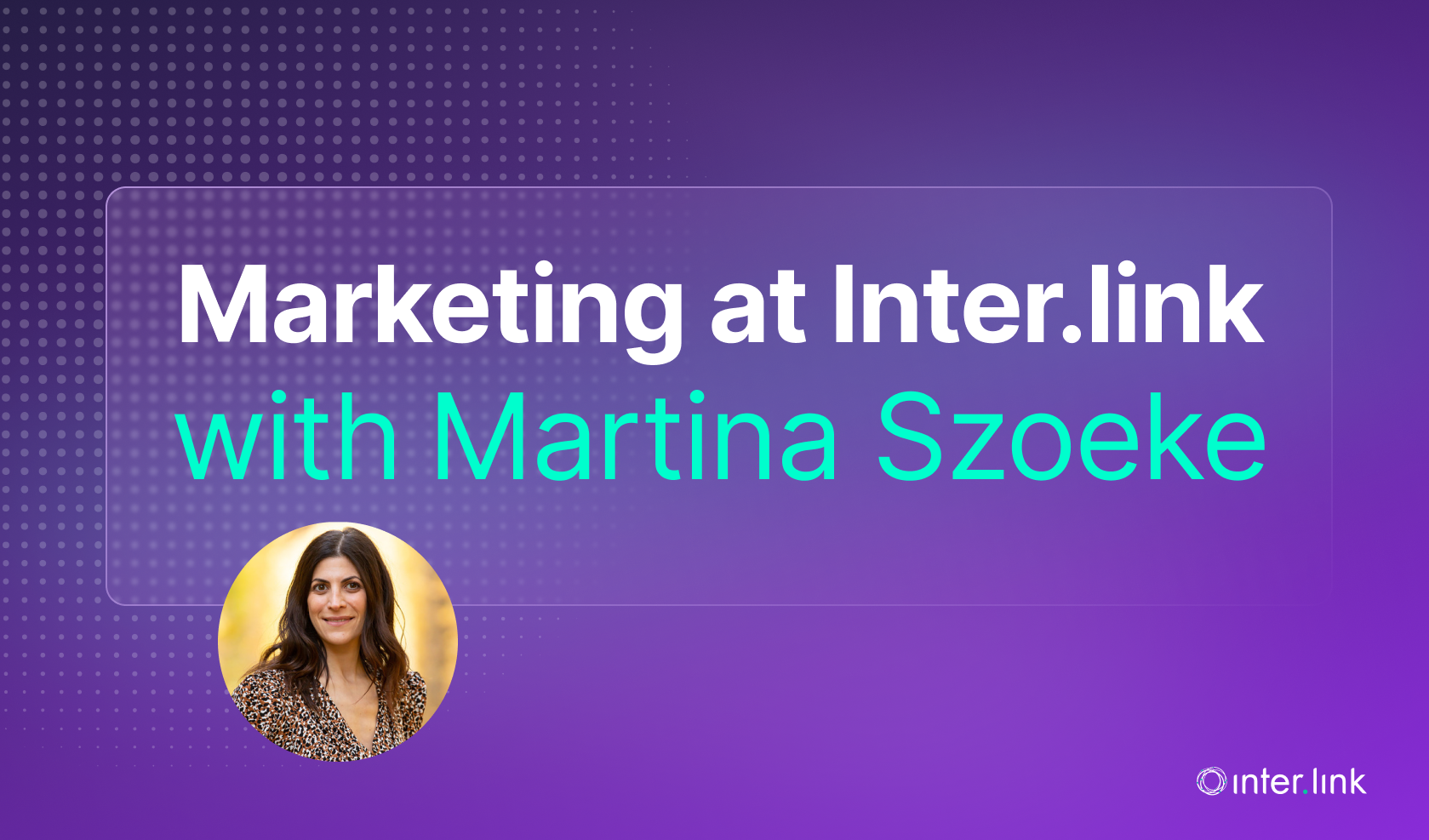
Martina Szoeke is Inter.link’s Team Lead for Marketing and in this article she explains her responsibilities, marketing a technical product, and working in the network industry.
What does a typical day in Marketing at Inter.link look like?
There’s not really one “typical” day, which is probably one of the things I enjoy most about working at a startup. My day can involve anything from working on content and campaigns to planning upcoming events, coordinating with the tech or sales team on new initiatives or figuring out how to communicate a new product we’re working on. Because we’re a small team, there’s a lot of variety and you tend to be involved in projects from the initial idea all the way through to execution.
What’s different about marketing a highly technical product?
You must find the right balance between being technically accurate and making the message clear and interesting. Our audience is highly knowledgeable, so relying on vague marketing language doesn’t resonate with our audience. There needs to be substance behind what you’re saying. At the same time, it’s a fine balance. You don’t want every piece of communication to read like technical documentation. A big part of the job is understanding what’s technically important and translating that into why someone should care about it. This involves a lot of cross- team work and alignment between engineering and pre-sales in order make sure the messaging is technically correct but also consistent.
How closely does marketing work with technical teams?
Almost everyone we communicate starts with the technical teams, whether that’s a new product, feature, network development, or an interesting technical insight. Marketing’s role is often to ask questions, understand what’s happening and why it matters, and then turn that into a story that makes sense for the audience. That collaboration is also important for making sure what we put out is accurate and credible.
What is your favorite part of the role?
Probably the variety and the amount of ownership you get. You can be working on something creative one moment and then discussing a very technical topic the next. I also like being able to take an idea from the very beginning, develop it into something tangible, and eventually see it go out into the world.
What is the hardest part about marketing in the network industry?
The complexity. There are topics that are genuinely interesting and important but can be difficult to communicate simply without losing the technical detail that makes them meaningful. You’re also marketing to an audience that often understands the subject extremely well, so credibility matters. It forces you to really understand what you’re talking about rather than just finding a nice way to package it.
What has surprised you the most about working in the Internet Infrastructure industry?
Probably how much is happening behind the scenes of something we all use constantly. Most people don’t really think about what happens when they open a website, stream something, or use an online service — it just works. Once you start working in the industry, you realize how much infrastructure, engineering, and coordination is involved in making that experience possible. There’s a whole world underneath the internet that most people never see.
What advice would you give someone marketing technical products?
Be curious and don’t be afraid to ask questions. You don’t necessarily need to be the most technical person in the room (I am absolutely not, and often feel like a neophyte), but you do need to genuinely understand what you’re marketing. Ask the “obvious” questions, learn from the technical people around you, and keep digging until you can explain the topic clearly in your own words. If you don’t understand why something matters, it’s going to be difficult to convince anyone else that it matters.
What is the one thing people don’t realize about marketing at a startup like Inter.link?
How broad the role can be. Marketing at a startup isn’t necessarily divided into very specific areas where everyone only does one thing. You can be involved in strategy, content, events, social media, product marketing, brand, campaigns and plenty of things in between. There’s a lot of freedom to bring forward ideas and experiment, but there’s also a lot of responsibility to make those ideas happen.