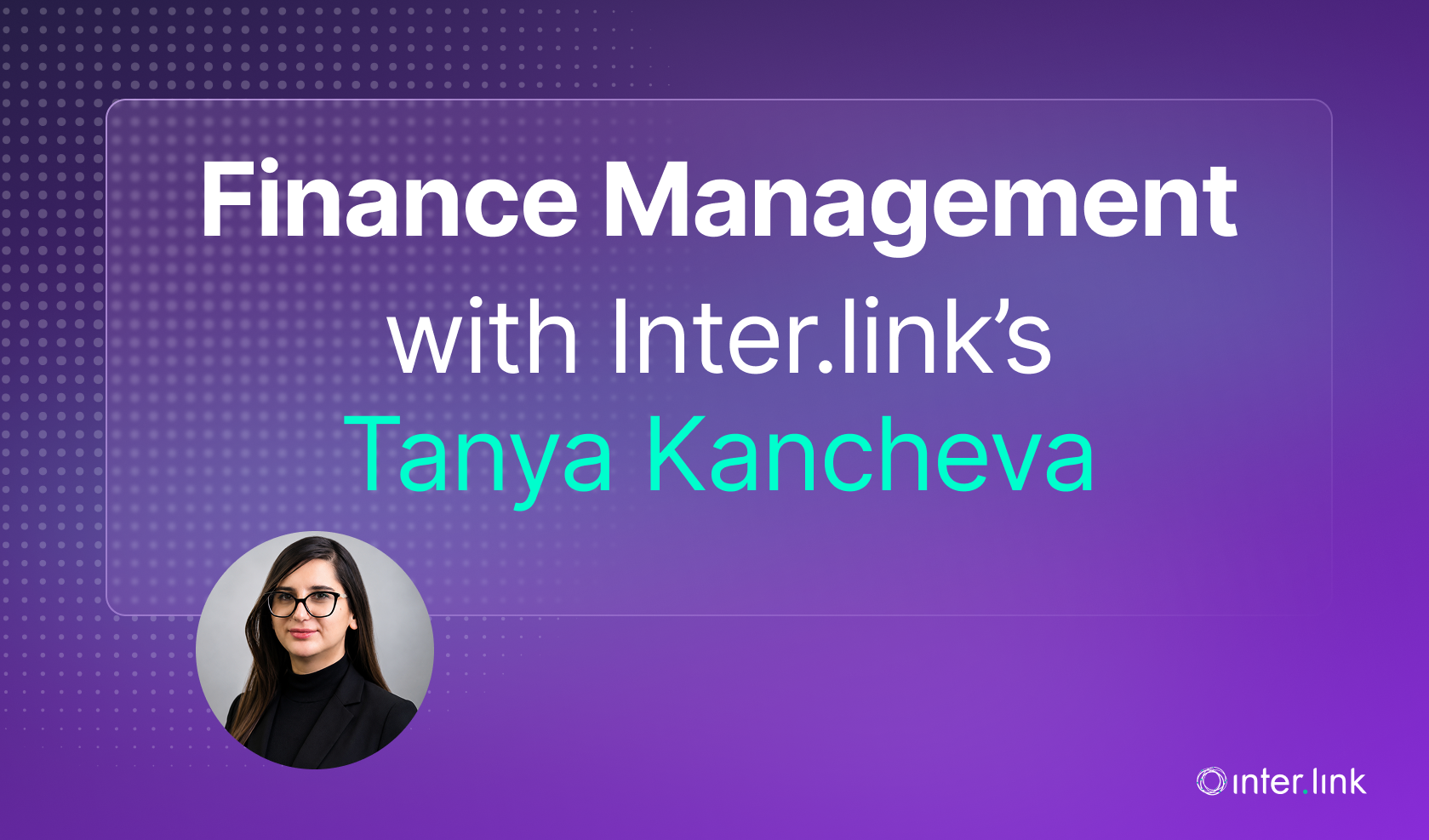
Tanya Kancheva is one of Inter.link’s Senior Finance Managers and in this article she explains her responsibilities, her experience joining Inter.link, and working in finance across different industries.
What does a typical day look like in Finance at Inter.link?
The honest answer to this question is that there is no typical day and the variety is what makes this role so interesting. At the beginning of each week, I plan what to focus on – priorities, deadlines, where are we in the month cycle. But the days have a life on their own. Every morning I go through my to-dos, notes, emails and messages to see if anything needs to shift or be reprioritized. And then the day unfolds.
Sometimes it’s deep reconciliation work or preparations for the month-end-closure. Other days are more collaborative – coordinating with our tax advisor or other colleagues and working on process improvements. And sometimes something just pops up and changes the plan entirely. That is what I enjoy most – the ability to shift between different tasks and stay flexible. Finance isn’t a static function and treating it as one is where people go wrong. You need to be structured enough to plan but agile enough to adapt.
What made settling into this rhythm so much easier was how welcoming and helpful the whole team was from day one. When you join a new company, especially remotely, that human warmth makes an enormous difference.
What is something that has surprised you since joining Inter.link?
How much you can achieve with a small, focused team. Coming from larger organization I was used to processes being spread across many people and departments. At Inter.link the pace is completely different. Decisions happen fast, things get built quickly and you can see the direct impact of your work almost immediately. But what surprised me even more was how well everything works together in a remote environment. The level of coordination, communication and operational smoothness is something I genuinely didn’t expect. Everything just clicks and makes a real difference to how you work every day.
Is running finance in the network industry much different from other industries you have worked in?
Honestly when I first joined Inter.link my biggest fear was exactly this question. I have worked in the food industry, chemical distribution, fintech and mobility. And suddenly I was in network infrastructure – an industry I knew nothing about and was not sure how quickly I could get up to speed. What I discovered is that industry matters far less than I thought. The core principles are universal – reconciliations, month-end close, cash flow compliance – they travel with you wherever you go. And if you want to simplify it even further, finance is always about the same thing: paying and being paid. The industry changes the context, the people change the experience. At Inter.link I work with people who are focused, smart, and genuinely passionate about what they’re building. That energy is contagious and helps you adapt quickly regardless of whether you knew what IP Transit was on day one.
What do you enjoy about your role?
The ownership and the philosophy behind it. I really value the freedom to explore and contribute to my role but also being encouraged to look beyond it and suggest improvements. That creative space within a finance role is what makes me feel like I am in the right place.
What advice would you give someone entering finance as a career?
Build broad before going deep. Early in my career I worked across AP, AR , accounting, quality management and reporting simultaneously and that breadth gave me a foundation that pure specialists sometimes miss. Understand how finance connects to the rest of the business – not just the numbers themselves.
Finance has a reputation for being the boring department – the people who say no, who live in spreadsheets and slow everything down. I think that’s a consequence of functions that exist for themselves rather than for the business. The best finance function is almost invisible and enables other departments rather than creating obstacles for them.
Think of yourself as a bridge between the other departments. When finance speaks the language of every department, it becomes an asset, not a liability.